

Bitcoin has captivated global financial markets since its inception in 2009, transforming from a niche digital experiment into a trillion-dollar asset class that influences institutional portfolios, regulatory conversations, and macroeconomic discourse. As of early 2025, Bitcoin continues to exhibit the volatility that has defined its history, leaving investors, analysts, and curious observers searching for clues about its future trajectory. This comprehensive analysis examines the methodologies analysts employ, the historical patterns that inform projections, and the various factors that could shape Bitcoin’s price in the coming years.
Understanding Bitcoin Price Forecasting Methods
Price forecasting for Bitcoin differs fundamentally from traditional asset analysis due to Bitcoin’s unique characteristics. Unlike stocks or bonds, Bitcoin has no earnings, dividends, or interest rates to anchor its valuation. Instead, analysts rely on several distinct frameworks to project potential price movements.
Technical analysis forms the foundation of many short-term forecasts. Practitioners examine historical price patterns, moving averages, relative strength indicators, and volume data to identify trends and potential reversal points. Chart patterns such as head-and-shoulders formations, double tops, and ascending triangles have historically signaled price movements that analysts use to extrapolate future values.
On-chain metrics provide another analytical layer unique to Bitcoin. These measurements track activity directly on the blockchain, including wallet addresses, transaction volumes, exchange flows, and miner behavior. Metrics such as the Network Value to Transactions Ratio (NVT) and Hash Rate offer insights into network health and user adoption that pure price analysis cannot capture.
The Stock-to-Flow model, popularized by analyst PlanB, represents one of the most discussed frameworks in Bitcoin forecasting. This model compares Bitcoin’s existing supply (stock) to its annual production rate (flow), creating a ratio that correlates with price movements. The model suggests that Bitcoin’s deflationary supply schedule—with block rewards halving approximately every four years—should drive prices higher over time as scarcity increases.
Historical Performance and Cycle Analysis
Bitcoin’s price history reveals remarkable patterns that analysts study to inform predictions. Since its creation, Bitcoin has undergone multiple boom-bust cycles, with each cycle peaking at significantly higher levels than the previous one.
The first major cycle peaked in late 2013, when Bitcoin reached approximately $1,100 before retreating. The subsequent bear market lasted nearly three years, with prices falling over 80% from the peak. The 2017 cycle saw Bitcoin surpass $19,000 in December of that year, representing a new high-water mark that exceeded the previous peak by roughly 17x. Another severe contraction followed, with Bitcoin falling below $3,200 by late 2018.
The 2020-2021 cycle produced Bitcoin’s all-time high of approximately $69,000 in November 2021, coinciding with unprecedented institutional adoption and macroeconomic stimulus. This cycle demonstrated how traditional market dynamics—such as Federal Reserve policy and inflation concerns—increasingly influence Bitcoin pricing.
Analyzing these cycles, some analysts identify a pattern of roughly four-year periods between major tops, aligning with Bitcoin’s halving events. This temporal regularity, combined with diminishing supply inflation, forms the basis for many long-term bullish projections.
Bullish Price Predictions: Analysis and Context
Various analysts and institutions have published Bitcoin price predictions, each employing different methodologies and assumptions. Understanding the context behind these projections is essential for evaluating their credibility.
Several prominent analysts have suggested six-figure Bitcoin prices based on adoption trajectories and scarcity models. Analyst Michael Saylor, founder of MicroStrategy, has consistently advocated for Bitcoin as a treasury reserve asset, arguing that corporate and institutional adoption could drive significant demand that outpaces supply. His company has accumulated over $10 billion in Bitcoin holdings, representing one of the largest corporate treasury positions in the cryptocurrency.
Investment bank perspectives have evolved considerably. Goldman Sachs has acknowledged Bitcoin’s potential as an alternative asset, while JPMorgan analysts have discussed scenarios where Bitcoin could compete with gold as a store of value, potentially reaching prices significantly above current levels if such a transition occurs.
Analysts at Ark Invest have published models suggesting Bitcoin could reach equilibrium prices far higher than current levels under certain adoption scenarios. Their research examines user growth curves and network effects to project potential valuations.
The Stock-to-Flow model and its variants have projected prices ranging from $100,000 to over $1 million based on historical correlations between the model’s predictions and realized prices. While the model has faced criticism following deviations in recent years, its supporters point to the fundamental supply dynamics that drive its projections.
Factors That Could Drive Bitcoin Higher
Multiple catalysts could contribute to bullish price scenarios in the coming years. Understanding these potential drivers helps contextualize optimistic predictions.
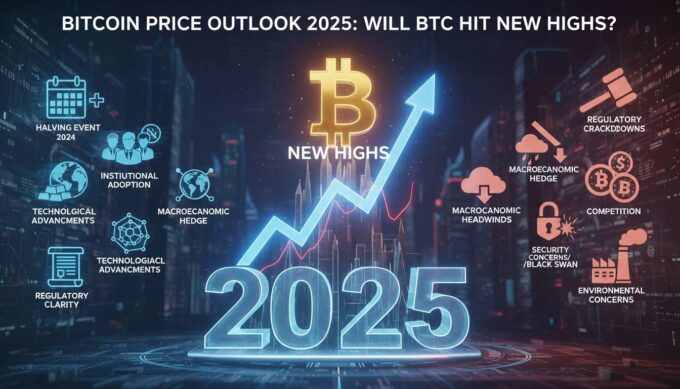
Institutional adoption continues accelerating, with major financial institutions offering Bitcoin custody, trading, and investment products. The approval of Bitcoin ETFs in the United States in early 2024 marked a watershed moment, providing mainstream investors regulated access to Bitcoin exposure. This development alone has introduced billions of dollars in new capital into the Bitcoin market through vehicles familiar to traditional investors.
Scarcity dynamics remain fundamental to Bitcoin’s appeal. With approximately 19.7 million Bitcoin already mined and the total supply capped at 21 million, the asset inherently possesses deflationary characteristics. Each halving event reduces the new supply entering the market, historically creating supply shocks that coincide with price appreciation.
Macroeconomic conditions significantly influence Bitcoin valuations. Many investors view Bitcoin as an inflation hedge, similar to gold, particularly in environments of expanding money supplies and fiscal deficits. As global debt levels continue rising and currency values face structural pressures, some investors position Bitcoin as a potential hedge against monetary debasement.
Regulatory clarity, while sometimes viewed as a threat, could ultimately benefit Bitcoin by providing institutional investors with confidence that regulatory frameworks will protect their interests. Clear rules governing custody, trading, and taxation could unlock significant additional capital that currently remains on the sidelines.
Risk Factors and Bearish Considerations
Balanced analysis requires acknowledging factors that could constrain Bitcoin’s growth or trigger significant declines.
Regulatory crackdowns represent a persistent risk. Governments worldwide maintain authority to restrict cryptocurrency trading, mining, or usage, and coordinated international action could significantly impair Bitcoin’s utility. China’s ban on mining operations in 2021 demonstrated how regulatory action can impact supply chains and market sentiment.
Bitcoin’s volatility remains a significant barrier to mainstream adoption as a medium of exchange. Merchants and consumers seeking price stability may find Bitcoin’s daily swings impractical for transactions, limiting its use case to primarily store-of-value applications.
Environmental concerns surrounding Bitcoin mining continue generating criticism, particularly regarding energy consumption. While renewable energy adoption in mining operations has increased, negative public perception could influence regulatory attitudes and corporate adoption policies.
Competition from alternative cryptocurrencies presents another consideration. While Bitcoin maintains dominant market position and brand recognition, competing blockchain networks offer different technical features and use cases that some investors prefer.
Technical vulnerabilities, including exchange hacks, wallet thefts, and protocol-level bugs, represent ongoing security concerns. While Bitcoin’s network has proven remarkably resilient, individual participant security failures have resulted in significant losses.
Making Informed Investment Decisions
Prospective Bitcoin investors should approach the asset with clear understanding of its characteristics and risks. No prediction or forecast should substitute for individualized financial planning.
Position sizing represents a critical consideration. Due to Bitcoin’s volatility, financial advisors often recommend limiting cryptocurrency allocations to a small percentage of total portfolios—typically 1-5% for conservative investors. This approach allows participation in potential upside while limiting exposure to severe drawdowns.
Dollar-cost averaging strategies have proven popular among Bitcoin investors, spreading purchases across time periods to reduce the impact of volatility. This systematic approach eliminates the need to time market entries, historically performing well in trending markets.
Secure storage practices protect investments from loss or theft. Hardware wallets, cold storage solutions, and proper key management prevent the exchange failures and hacks that have historically caused investor losses.
Thorough research before any investment remains essential. Understanding Bitcoin’s technical foundations, historical performance, and risk factors enables informed decision-making that aligns with individual financial circumstances and risk tolerance.
Frequently Asked Questions
What is the most accurate Bitcoin price prediction method?
No single method has proven consistently accurate for Bitcoin price prediction. Technical analysis works for identifying trends and patterns but fails during fundamental shocks. On-chain metrics provide valuable network health indicators but don’t account for macroeconomic factors. Stock-to-flow models correlate with historical prices but have deviated significantly in recent years. Most sophisticated analysts combine multiple methodologies while acknowledging substantial uncertainty inherent in any projection.
How often does Bitcoin undergo its halving event?
Bitcoin’s halving occurs approximately every four years, or precisely every 210,000 blocks. The event reduces the block reward granted to miners by 50%, decreasing new Bitcoin issuance. Historical analysis suggests halving events have preceded major bull runs, though correlation doesn’t guarantee future results. The most recent halving occurred in April 2024, reducing the block reward from 6.25 BTC to 3.125 BTC.
Should I invest in Bitcoin based on price predictions?
Price predictions should not form the sole basis for investment decisions. All predictions carry significant uncertainty, and no analyst or model can guarantee future prices. Before investing in Bitcoin, individuals should understand the asset’s volatility, conduct independent research, assess their risk tolerance, and consider consulting financial advisors. Never invest more than you can afford to lose.
What minimum investment is needed to buy Bitcoin?
Bitcoin is divisible to eight decimal places (0.00000001 BTC), meaning investors can purchase fractions of a single Bitcoin. Most exchanges allow minimum purchases of $1 or less, making Bitcoin accessible regardless of portfolio size. However, transaction fees may make very small purchases impractical on some platforms.
Is Bitcoin a safe investment?
Bitcoin carries substantial risk, characterized by dramatic price swings and market uncertainty. It is not insured by the FDIC or similar protections, and investors can lose their entire investment. While Bitcoin has generated significant returns over its history, past performance doesn’t guarantee future results. Investors should carefully consider their financial situation and risk tolerance before investing.
What drives Bitcoin prices up or down?
Bitcoin prices respond to supply and demand dynamics, including investor sentiment, macroeconomic conditions, regulatory developments, institutional adoption, and technological changes. Mining difficulty, exchange flows, and network activity also influence prices. Unlike traditional assets, Bitcoin lacks fundamental metrics like earnings or interest rates, making price discovery more dependent on speculative factors.
Conclusion
Bitcoin forecasting remains an exercise in probability rather than prediction. The asset’s unique characteristics—fixed supply, decentralized structure, and growing institutional adoption—create conditions that some analysts view as structurally bullish. Historical patterns suggest higher highs over extended timeframes, though volatility and uncertainty characterize short-term movements.
The convergence of institutional adoption, regulatory clarity, and macroeconomic tailwinds could support continued price appreciation in bullish scenarios. However, regulatory risks, competitive pressures, and volatility demand careful consideration from prospective investors.
Ultimately, Bitcoin’s future depends on complex interactions between technological adoption, regulatory frameworks, and broader economic conditions that no model can fully capture. Investors approaching Bitcoin should do so with clear understanding of its speculative nature, appropriate position sizing, and realistic expectations for both potential returns and possible losses.









Leave a comment