

Bitcoin remains one of the most debated investment opportunities in modern finance. With price volatility, regulatory developments, and shifting institutional sentiment, determining whether to invest requires careful analysis of current market conditions, your personal financial situation, and understanding of cryptocurrency fundamentals. This guide provides expert perspectives, key metrics, and actionable insights to help you make an informed decision.
📊 STATS
• Bitcoin’s market capitalization exceeds $1.2 trillion as of 2024 (CoinMarketCap)
• Approximately 19.6 million Bitcoin are in circulation out of a maximum 21 million
• Institutional Bitcoin holdings by publicly traded companies exceed $60 billion
• Bitcoin has delivered over 8,000% cumulative returns since 2010 (Historical price data)
Key Takeaways
• Volatility Remains High: Bitcoin experiences daily price swings of 3-5% regularly, significantly higher than traditional assets.
• Institutional Adoption Growing: Major financial institutions now offer Bitcoin products, signaling increased legitimacy.
• Regulatory Landscape Evolving: Global regulatory frameworks are developing, which could impact future value and accessibility.
• Long-Term Performance Strong: Despite short-term volatility, Bitcoin has outperformed most asset classes over 10+ year horizons.
• Risk Tolerance Matters: Only money you can afford to lose should be considered for Bitcoin investment due to inherent volatility.
What Is Bitcoin and How Does It Work?
Bitcoin is a decentralized digital currency created in 2009 by an anonymous entity known as Satoshi Nakamoto. Unlike traditional currencies issued by governments and central banks, Bitcoin operates on a peer-to-peer network using blockchain technology—a distributed ledger that records all transactions across thousands of computers worldwide.
Core Components
Blockchain Technology:
Bitcoin transactions are recorded on a public ledger called the blockchain. Each “block” contains a group of transactions, and these blocks are linked together cryptographically, making the record tamper-resistant. This eliminates the need for intermediaries like banks to verify transactions.
Mining and Supply:
New Bitcoin enters circulation through mining—a computational process where miners solve complex mathematical puzzles to validate transactions and add new blocks to the blockchain. This process secures the network and introduces new coins at a predetermined rate. The mining reward halves approximately every four years in an event called “halving,” which reduces new supply issuance.
Wallet Security:
Bitcoin holdings are stored in digital wallets protected by private keys—cryptographic codes that authorize transactions. Wallets can be “hot” (connected to the internet) or “cold” (offline storage), with cold wallets generally considered more secure for large holdings.
💡 STAT: Bitcoin’s fixed supply of 21 million coins contrasts sharply with unlimited fiat currency printing, which some investors cite as inflation protection (Satoshi Nakamoto, Bitcoin Whitepaper, 2008).
How Bitcoin Transactions Work
When you send Bitcoin, your transaction is broadcast to the network and grouped with other pending transactions into a mempool. Miners then select transactions from the mempool, verify the sender has sufficient funds and proper authorization (via private key), and include the transaction in a new block. Once confirmed by the network, the transaction becomes irreversible—this is why wallet security and double-checking addresses are critical.
Benefits and Risks of Bitcoin Investment
| Factor | Impact | Consideration |
|---|---|---|
| Potential Returns | High historical returns | Past performance does not guarantee future results |
| Diversification | Low correlation to stocks | Some investors use Bitcoin as portfolio diversifier |
| Liquidity | 24/7 trading | Higher than many traditional assets |
| Accessibility | Global, permissionless | Anyone with internet access can invest |
| Volatility | ±3-5% daily swings | Significantly higher risk than bonds or savings |
| Regulation | Evolving uncertainty | Future regulations could impact value |
Investment Advantages
Store of Value Narrative:
Proponents argue Bitcoin functions as “digital gold”—a store of value with scarcity built into its code. With only 21 million coins ever existing, inflation through supply expansion is mathematically impossible. This contrasts with government currencies that can be printed indefinitely.
Decentralization:
Bitcoin operates without central authority, making it resistant to government interference or manipulation. For investors concerned about monetary policy or currency devaluation, this decentralization represents a fundamental value proposition.
Global Accessibility:
Bitcoin can be transferred globally within minutes to hours, regardless of borders. This makes it attractive for cross-border transactions and provides financial access to unbanked populations worldwide.
Transparency:
All Bitcoin transactions are publicly visible on the blockchain, allowing for unprecedented transparency in financial movements (though wallet addresses can be pseudonymous).
📈 CASE: MicroStrategy, a business intelligence company, transformed into a Bitcoin treasury company in 2020, accumulating over 400,000 BTC (worth approximately $17 billion at recent prices). The company’s stock has significantly outperformed the S&P 500 during this period, though this comes with substantial volatility.
How to Invest in Bitcoin: A Step-by-Step Guide
Prerequisites:
– [ ] Government-issued ID for verification
– [ ] Bank account or payment method
– [ ] Risk tolerance assessment completed
– [ ] Investment budget you can afford to lose
– [ ] Secure storage plan for holdings
Time: 15-30 minutes for setup | Ongoing: Variable based on strategy
Steps
1. Choose a Reputable Exchange
Selecting the right platform is your first critical decision. Major U.S.-based exchanges include Coinbase, Kraken, and Gemini—all of which comply with regulatory requirements and offer varying fee structures.
- Compare fee schedules (trading fees typically range 0.1-0.5%)
- Verify security features (two-factor authentication, cold storage)
- Check available payment methods (bank transfer, debit card)
⏱ Time: 15 minutes | 💡 Tip: Start with a smaller exchange to test the process before moving larger amounts.
2. Complete Account Verification
U.S. exchanges require Know Your Customer (KYC) compliance. Prepare:
– Valid government ID
– Social Security Number
– Proof of address (utility bill or bank statement)
Verification typically completes within minutes to hours, though高峰期 may take longer.
3. Fund Your Account
Connect your bank account or add a payment method. Bank transfers (ACH in the U.S.) usually offer the lowest fees but take 3-5 business days. Debit card purchases are faster but carry higher fees (typically 3-5%).
4. Make Your First Purchase
Start with a small amount to familiarize yourself with the process. Bitcoin can be purchased in fractional amounts—you don’t need to buy a whole coin.
⚠️ Avoid: Investing more than you can afford to lose in your first session.
→ Fix: Set a strict budget before logging in and stick to it.
5. Secure Your Investment
For amounts exceeding a few hundred dollars, consider transferring holdings to a personal wallet:
- Hardware wallets (Ledger, Trezor): Physical devices storing keys offline—best security
- Software wallets (Exodus, Electrum): Applications on your device—convenient but less secure
- Paper wallets: Physical printed keys—air-gapped but can be lost or damaged
Troubleshooting:
| Problem | Fix |
|---|---|
| Transaction pending | Network congestion causes delays; wait or increase fee |
| Verification delayed | Contact support with documentation; check spam folder |
| Cannot withdraw funds | Complete full account verification; check withdrawal limits |
| Price dropped after purchase | Dollar-cost averaging continues per strategy; avoid emotional decisions |
Bitcoin vs. Alternative Investments
| Factor | Bitcoin | Ethereum | Gold | S&P 500 |
|---|---|---|---|---|
| Volatility (30-day) | 4-6% | 5-8% | 1-2% | 1-2% |
| 24/7 Trading | ✅ Yes | ✅ Yes | ✅ (some) | ❌ No |
| Supply | Fixed 21M | Unlimited | Limited by mining | Unlimited |
| Correlation to Stocks | Low-Medium | Medium | Low | 1.0 |
| Store of Value | Debated | Evolving | Established | Growth |
Bitcoin
✅ Strengths: Highest potential returns, fixed supply, decentralized, global accessibility
❌ Weaknesses: Extreme volatility, regulatory uncertainty, technical complexity
💰 Price Range: Highly variable; current prices around $60,000-$70,000 range
🎯 Best For: Risk-tolerant investors seeking high-growth potential and portfolio diversification
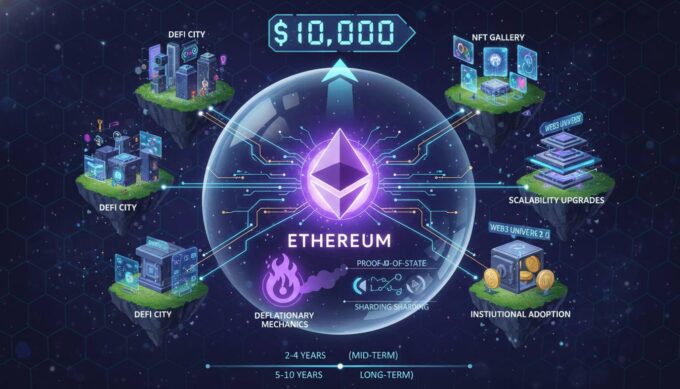
Ethereum
✅ Strengths: Smart contract functionality, DeFi ecosystem, strong developer community
❌ Weaknesses: Higher complexity, ongoing network upgrades, competition from other blockchains
💰 Price Range: Several thousand dollars
🎯 Best For: Investors interested in blockchain technology beyond simple store of value
Gold
✅ Strengths: Centuries of proven store of value, physical tangible asset, low correlation to stocks
❌ Weaknesses: No yield, storage costs, limited upside potential compared to Bitcoin
💰 Price Range: ~$2,300 per ounce
🎯 Best For: Conservative investors seeking inflation protection and portfolio insurance
Traditional Index Funds
✅ Strengths: Historical 10% annual returns, low fees, instant diversification, regulatory clarity
❌ Weaknesses: No exposure to potential cryptocurrency upside, slower growth potential
💰 Price Range: Varies by fund
🎯 Best For: All investors building long-term wealth with moderate risk tolerance
Common Mistakes to Avoid
| Mistake | Impact | Solution |
|---|---|---|
| Investing More Than You Can Afford | Financial stress, forced selling at losses | Stick to 1-5% of investable assets maximum |
| Chasing Price Movements | Buying at peaks, selling at bottoms | Use dollar-cost averaging instead |
| Ignoring Security | Hacked accounts, lost funds | Enable 2FA, use hardware wallet for large holdings |
| Failing to Research | Misunderstanding fundamentals | Read whitepaper, understand technology before investing |
| Emotional Decision-Making | Panic selling, FOMO buying | Create investment plan and stick to it |
⚠️ CRITICAL: The most damaging mistake is investing money you cannot afford to lose. Bitcoin remains highly speculative—while some early investors became wealthy, many others have lost substantial amounts. Never invest rent money, emergency fund reserves, or money needed for essential expenses.
Prevent: Keep 3-6 months of expenses in traditional emergency savings before considering any cryptocurrency investment.
Expert Insights on Bitcoin Investment
👤 Michael Saylor, Executive Chairman at MicroStrategy
“Bitcoin is a property, not a security. It’s a digital commodity that people can own, hold, and transact with. The key is understanding it as a long-term treasury reserve asset rather than a short-term trading vehicle.”
👤 Cathie Wood, CEO of ARK Invest
“We believe Bitcoin is an emerging asset class that offers asymmetric return profiles. Its non-correlated nature makes it attractive for portfolio diversification, though investors should understand the volatility profile.”
📊 BENCHMARKS
| Metric | Average Investor | Experienced Crypto Investor |
|---|---|---|
| Suggested Allocation | 1-3% of portfolio | 5-10% of portfolio |
| Investment Horizon | 5+ years | 3+ years |
| Risk Tolerance Required | High | Very High |
| Volatility Expectation | ±50% annually | ±70% annually |
Essential Tools and Resources
| Tool | Cost | Purpose | Rating |
|---|---|---|---|
| Coinbase | Free-$0.99+ | Beginner-friendly buying/selling | ⭐⭐⭐⭐⭐ |
| Kraken | 0-0.26% | Advanced trading features | ⭐⭐⭐⭐⭐ |
| Ledger Nano | $79+ | Secure hardware wallet | ⭐⭐⭐⭐⭐ |
| CoinGecko | Free | Price tracking and research | ⭐⭐⭐⭐ |
| Blockchain.com | Free | Wallet and block explorer | ⭐⭐⭐⭐ |
Top Recommendations:
• For Beginners: Coinbase—easiest interface, insured holdings, widely available
• For Security: Ledger hardware wallet—cold storage for holdings over $1,000
• For Research: CoinGecko—comprehensive metrics, transparent data, no account required
Frequently Asked Questions
Is now a good time to invest in Bitcoin?
The answer depends on your individual financial situation, risk tolerance, and investment timeline. Bitcoin remains volatile, and timing the market is extremely difficult. If you’re considering investing, dollar-cost averaging—investing fixed amounts at regular intervals regardless of price—helps reduce timing risk. Never invest money you cannot afford to lose.
How much should I invest in Bitcoin?
Most financial advisors suggest limiting cryptocurrency investments to 1-5% of your total investment portfolio. This allows exposure to potential upside while limiting downside risk. Your exact allocation should reflect your age, financial goals, other investments, and comfort with volatility.
Is Bitcoin safe to invest in?
Bitcoin itself uses cryptographic security, but investment safety depends on how you store your holdings. Major U.S. exchanges provide security features including insurance for certain holdings and two-factor authentication. For larger investments, hardware wallets provide superior security. However, all investments carry risk, and Bitcoin’s price volatility makes it inherently riskier than traditional assets.
What happens when all Bitcoin is mined?
After approximately 2140, all 21 million Bitcoin will be in circulation. At that point, miners will no longer receive new coin rewards and will rely on transaction fees as compensation. This is designed to maintain network security without inflation from new supply creation.
Conclusion
Whether to invest in Bitcoin ultimately depends on your individual circumstances, risk tolerance, and investment goals. The cryptocurrency has evolved from an experimental technology to a legitimate asset class with institutional adoption, but it remains significantly more volatile than traditional investments.
If you decide to invest, approach Bitcoin as a high-risk, potentially high-reward component of a diversified portfolio. Use reputable exchanges, enable strong security measures, and consider dollar-cost averaging to manage volatility. Never invest more than you can afford to lose, and maintain adequate emergency savings before considering any cryptocurrency investment.
The decision to invest in Bitcoin should align with your overall financial plan—not speculative hopes of quick wealth. For many investors, a small allocation (1-3%) provides exposure to potential upside while maintaining portfolio stability. For others with higher risk tolerance and longer time horizons, larger allocations may be appropriate.
Remember: informed decisions outperform emotional ones. Understand what you’re investing in, why you’re investing, and have an exit strategy before entering any position.









Leave a comment